Hilden, Glenmore and Lambeg War Memorial
Researched by Nigel Henderson, with input from John McCormick
On Saturday 29th October 1921, a monument commemorating the men from the Hilden, Glenmore, and Lambeg areas who died in the Great War was unveiled by Mrs Anna Barbour OBE JP.
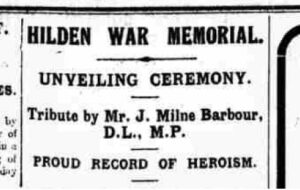
Belfast News-Letter – 31 October 1921
The monument was designed by Blackwood & Jury (Civil Engineers Architects of 41 Donegall Place, Belfast) and was built by Robert McHenry at the junction of Low Road and Mill Street on a plot of land donated by Richardson, Sons & Owden Limited of Donegall Square North, Belfast. The hexagonal monument with a domed top is built of Portland stone and is thirteen feet and six inches tall. Three of the faces are buttresses with moulded caps and bases. The other three faces are recessed and contain bronze plaques naming 117 fatalities.
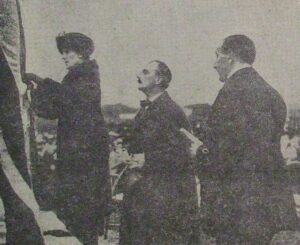
Belfast Telegraph -1 November 1921
Research facilitated by History Hub Ulster has identified details for 110 of the men named on the memorial.
The first fatality belonged to the Royal Marine Light Infantry. James Holmes was born on 6th May 1896 at Low Road to Thomas Holmes and Annie Harvey. James enlisted on 31st August 1914 but died of Cerebrospinal Meningitis on 2nd March 1915, at the aged of 19, and is buried in the Portland Royal Naval Cemetery in England.
The last fatality was from one of the area’s leading families, the Ewarts of Derryvolgie House. William Basil Ewart was born on 25th September 1890 at Glenmachan House to Frederick William Ewart and Mary Anne Elizabeth Valentine. Major Ewart was deployed to France with the Royal Irish Rifles in October 1915. He married Rebe Annette Grindle on 31st July 1917 and was invalided out of army service in November. He died of Chronic Nephritis at Derryvolgie House on 13th February 1920, ages 29, and is buried in the historic Clifton Street Graveyard in Belfast. His brother, Captain Cecil Frederick Kelso Ewart, Royal Irish Rifles, was Killed in Action on 1st July 1916, aged 28, and is commemorated on the Thiepval Memorial in France.
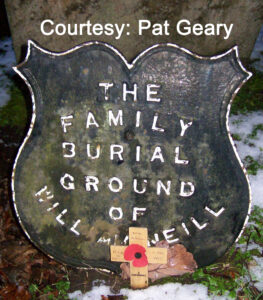 The youngest fatality was only 17 years old. Rifleman David Martin, Royal Irish Rifles, was Killed in Action on 17th June 1916 and is buried in Authuile Military Cemetery in France. He was born on 27th April 1899 at Ballynahinch Road to David Martin and Annie Singleton.
The oldest fatality was 48 years old. Private William Neill, Royal Inniskilling Fusiliers, who was Killed in Action on 21st August 1915 and is commemorated on the Helles Memorial on the Gallipoli Peninsula and at Lambeg Parish Church. He was born on 24th May 1867 at Ballyskeagh to John Neill and Jane McDermott and was married to Margaret Shields of Sandymount, Ballyskeagh.
Research to date shows that four men died after being taken prisoner by the Germans. Rifleman James Coburn served with the Royal Irish Rifles. He was reported missing during the Battle of St Quentin in March 1918, and it was confirmed that he was a prisoner of war two months later. 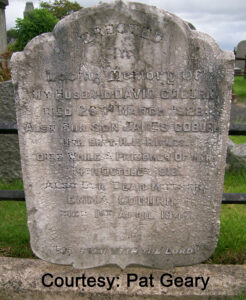 He died in captivity on 14th October 1918, aged 20, and is buried in the Belgrade Cemetery in Belgium and commemorated on a family memorial in Lisburn Cemetery.
He was born on 12th December 1897 at Hillsborough to David Coburn and Emma Livingston who later lived at Wilson Street.
As one might expect from the locality, the majority of the fatalities came from the Protestant community but there are at least eighteen Roman Catholics commemorated on the memorial. Rifleman Robert Costello was deployed to the 2nd Battalion Royal Irish Rifles on the Western Front in January 1915 and was awarded the Military Medal in 1917. 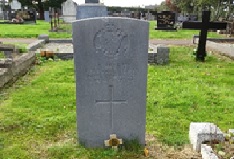 He died of Wounds at the Bath War Hospital on 14th January 1918, aged 28, and is buried in Holy Trinity Roman Catholic Cemetery in Lisburn. He was born on 24th August 1890 at Low Road to James Costello and Mary Grimley. A brother, Private Samuel Costello, served with the Royal Irish Rifles and the Royal Irish Regiment. He was discharged on 25th February 1919 and was allocated one of the twelve Ex-Servicemen’s Cottages built on Wallace Avenue in 1930.
Linen Families associated with Hilden War Memorial
Researched by Richard Graham
Hilden War Memorial is located on a traffic island bounded by Grand Street and Mill Street. The land for the memorial, in the form of an obelisk, was given to commemorate men from the Hilden, Glenmore and Lambeg area who died in the slaughter of the First World War (1914-18). The monument was designed by Percy Morgan Jury, a leading architect practising in Belfast, and a son of W J Jury, a Belfast Whiskey magnate and founder of Jury’s Hotels.
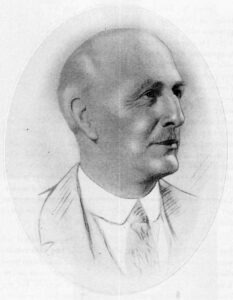
RHS Richardson
The land was gifted to the people of the area by the Richardson family, leading linen bleachers and manufacturers in the area and descendants from a Quaker family who settled in Ireland at Lisburn in the early 1700s. The Richardsons owned three linen production plants in the area: The Island Spinning Co (now LCCC Headquarters) Millbrook Bleachworks (now housing) and The Glenmore Bleachworks one of the largest of its type in Ireland. The family lived at two large estates in the Lambeg area: Glenmore House (now apartments) and Aberdelgy (now a Golf Course).
But it was to another leading employer in the area, that the unveiling ceremony was entrusted – that of the Barbour family of Hilden Mill.
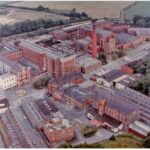
Hilden Mill
The War Memorial was officially unveiled on the morning of Saturday 29th October 1921 by Mrs Anna E Barbour, OBE, the American born wife of Harold Barbour – they lived at Strathearne, Dunmurry, now Hunterhouse College. They were in fact first cousins, her father having been born at The Fort, now Fort Hill College, before moving to America.
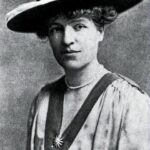
Anna E Barbour 1876-1941
The platform party also comprised members of several other leading linen families of the area: John McCance of Suffolk House (now Colin Glen Regional Park); Malcolm Gordon (manager of Hilden Mill) of Clonmore, Lambeg (latterly a community and arts facility); Frederick W Ewart, of the enormously successful Ewarts linen dynasty, who lived at nearby Derryvolgie House (latterly the divisional HQ of the Water Service and Mrs Emily Reade, whose husband was a director of the York Street Flax Spinning Co, and who had before her marriage been a Charley of Seymour Hill.
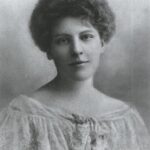
Elsie Milne Barbour
It commemorated the lives of 117 men from the local area who lost their lives in the Great War, aged from just 17 years to 48 years old – 55 of whom have no known place of burial.
Just a few yards from the War Memorial, there is a beautiful children’s park with an interesting stone inscribed E M B Memorial Park … but who was E M B?
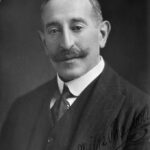
Sir Milne Barbour – 1 Jan 1900
Elsie Milne Barbour was the wife of Sir J Milne Barbour of Conway House, Dunmurry (latterly an hotel) the Chairman of Hilden Mill. Sadly, Elsie Barbour died during the birth of her third child, Elizabeth, in 1910 at the age of only 37 years old. In her memory, Sir Milne Barbour gave the land for the playground for local children and also built the EMB Memorial Hall which stood opposite the War Memorial until 2000.
The Barbour’s only son, John Milne Barbour, also died young in an air crash whilst flying a private plane from a Barbour plant in Scotland to Conway in 1937 at the age of 30.
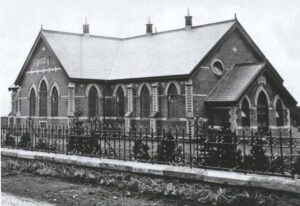
EMB Memorial Hall
So, that is the story behind two of Hilden’s memorials to those who gave the ultimate sacrifice for their country and the tragedy of the owning family of one of the largest linen thread factories in the world.
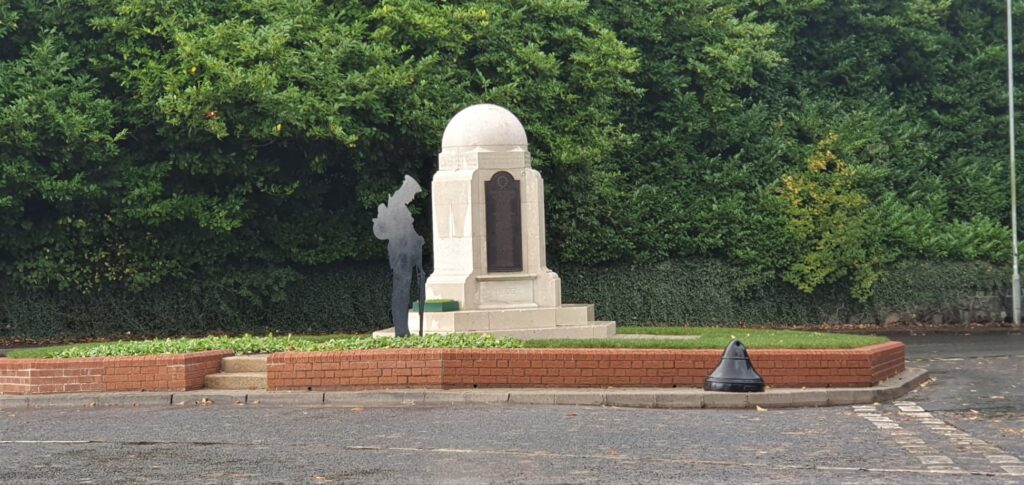
Hilden War Memorial
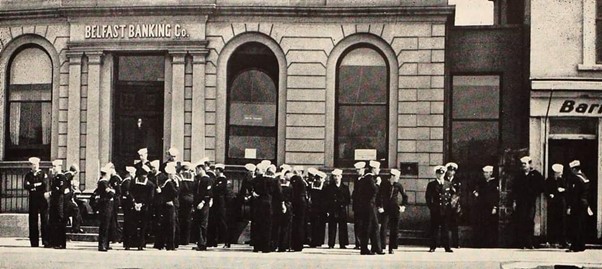
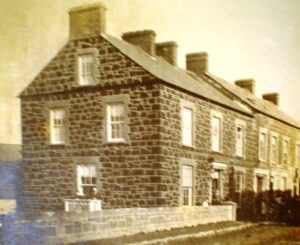 Whilst undertaking research into the Northern Bank in Bushmills, I came across a sad tale about the first branch manager of the Belfast Bank branch in that small village. In 1870, Thomas McComb (32) had been working in the Belfast Bank, Coleraine branch as Accountant and Cashier for 13 years when he was appointed Manager of their Bushmills Agency. He was widely respected in the town. This article presents the sad story of Thomas McComb through newspaper clippings and photographs.
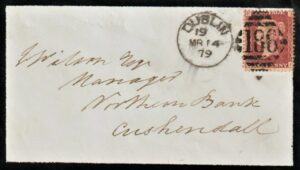 An old envelope addressed to ‘J Wilson, Manager, Northern Bank, Cushendall’ and postmarked ‘Dublin 19, 14th March 1879’ was recently discovered in an internet search. What is the story of this bank branch in the small County Antrim village of Cushendall? This article presents the history of the building through newspaper clippings and photographs.
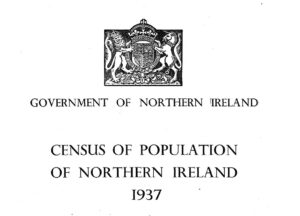 In order to bridge the gap between the census of 1926 and the census which it was intended to take in 1941, a census of more limited scope (e.g., omitting questions regarding occupation and industry) was taken in 1937. The returns were made as at midnight of 28th February – 1st March, 1937, and a Preliminary Report, containing population and other tables, was issued in July of that year.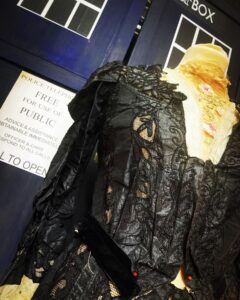
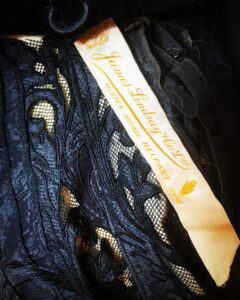 “I wonder can anyone help me with some research pointers for this dress – it carries the label James Lindsay &Co Ulster Arcade which I believe is the Lindsay Brothers – Thomas Lindsay, Mayor of Belfast in 1875? I know they were textile merchants (and very successful too) but I don’t know if they actually produced/commissioned clothing? Any info about the company very welcome”.
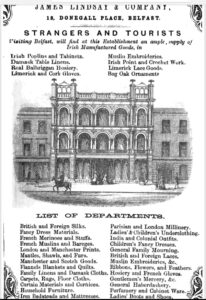
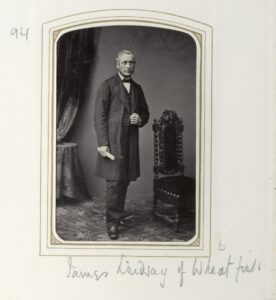 James Lindsay and Co was established at 18 Donegall Place, Belfast c 1860. The Lindsay family first came to Ireland from Scotland in 1678, with their descendants moving to Belfast in 1822, opening a “woollen, linen and haberdashery warehouse” trading as J & D Lindsay on Bridge Street. The business prospered and John and David Lindsay brought into the partnership their three younger brothers, one of whom was James Lindsay after which the business at 18 Donegall Place was named.
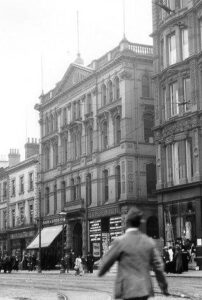 James Lindsay & Co was part of a much larger family business which traded under the name Lindsay Brothers. They first began manufacturing muslin in the early 1800s, but expanded the business to include the spinning of flax at two large mills (the Mulhouse Works and Prospect mills) and all associated processes involved in the rapidly developing linen industry. These goods were exported all over the world from their warehouse at 7-9 Donegall Place (see pic). This building still stands as the Disney Store today.
 The business continued to prosper for the next 80 years, and allowed James to reside at a large house and estate called “Wheatfield” at Ballysillan, North Belfast. The business concentrated on products of Irish Manufacture, and they were soon joined by other worldwide concerns such as Robinson & Cleaver which opened their Royal Irish Linen Warehouse two doors up on Donegall Place in 1888 – the year Queen Victoria granted Belfast it’s charter as a city.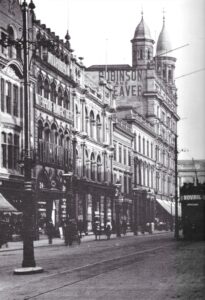
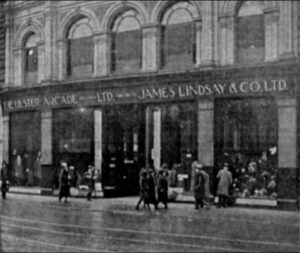
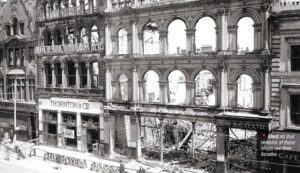
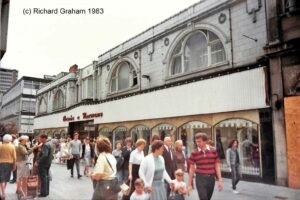 When the building was destroyed, Thomas Brand merged with Norman & Co on Castle Lane to form Brands & Normans. The Brand family also developed Brands Arcade (aka Birdcage Walk) becoming one of the most important fashion houses and retailers in Belfast in the “Swinging Sixties” Sadly that business has now also disappeared from the streets of Belfast, as has C&A, Robinson & Cleaver, Anderson & McAuley and all the other great stores, even up to last month when Debenhams closed down.
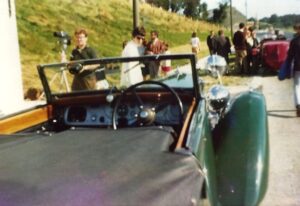 The history of Northern Ireland isn’t always about politics; it’s about people and sporting achievements too. Between 1928 and 1936 the RAC (Royal Automobile Club) ran the
 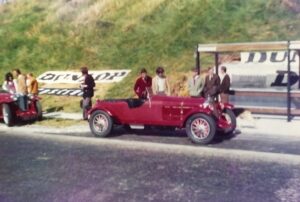 Gavin’s photographs, a few are shown here, feature in a short video uploaded to the
 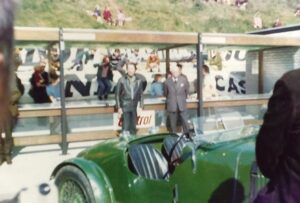 The memorial is in the form of a reconstruction of three of the pit ‘units’. These have been erected on the site of the original pits, close to the Rolls Royce factory outside Dundonald. Built of wood, the 10ft long structures were used by pit staff during races.
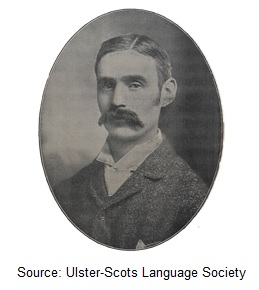 Archibald McIlroy of Drumbo was a stockbroker and Justice of the Peace who had emigrated to Canada with his wife to work as missionaries. Archibald was a published author in the Kailyard style, late 19th-century movement in Scottish and Ulster Scots writing that was characterised by a sentimental idealisation of humble village life. His novels captured the ethos of rural life, particularly from a Presbyterian perspective. Among his novels were When Lint was in the Bell, The Auld Meetin’ Hoose Green (1898), The Banker’s Love Story. Archibald and Anna McIlroy sailed in Second Class and Archibald, who was 55 years old, is commemorated on the war memorial tablet in Ballycairn Presbyterian Church, Ballylesson. Anna Caroline McIlroy died in Toronto on 21st July 1942 at the age of 77.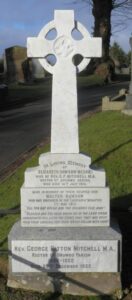
 A Typist
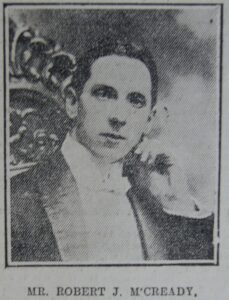 A Photographer
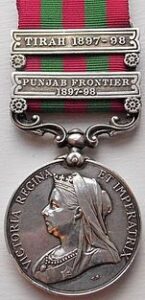
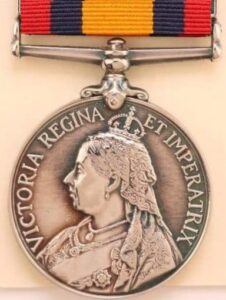 John Cleland was a chemist and a member of the Royal Irish Rifles militia when he enlisted with the Royal Inniskilling Fusiliers at Omagh on 11th March 1890. His period of engagement was seven years regular service and five years reserve service, but he extended his regular service in 1897. He served with 2nd Battalion Royal Inniskilling Fusiliers during the 1897/98 North Western Frontier campaign, being awarded the India Medal (1895) with Punjab Frontier 1897-98 and Tirah 1897-98 clasps. He was wounded during the Second Anglo-Boer War whilst serving with 1st Battalion Royal Inniskilling Fusiliers. On 30th March 1900, General Redvers Buller wrote to the Secretary of State for War listing cases of distinguished conduct in the field. Lance-Corporal John Cleland was included in the report as he had rendered very valuable assistance to the wounded under heavy fire on 23rd-24th February. John Cleland held the rank of Sergeant when he died of dysentery on 8th May 1901 at Middelburg in Transvaal Province. In addition to the Distinguished Conduct Medal, he was awarded the Queen’s South Africa Medal with four clasps – Belfast, Cape Colony, Tugela Heights, and Relief of Ladysmith.
 Gavin Bamford, Chair of History Hub Ulster