 Forgotten Female War Workers
In 1939, the Ulster Branch of the Missions to Seamen decided to provide a canteen to meet the needs of the men from British and allied naval ships docked in Belfast Harbour. The canteen was housed in premises at Pollock Dock owned by the Harbour Commissioners. The premises had formerly been part of the offices of Workman Clark. The Pollock Dock Naval Canteen, which included a spacious concert hall and facilities for games such as darts and billiards, was formally opened on 1st January 1940 by Rear Admiral Richard Matthew King DSO, Flag Officer in Charge for Belfast. The staff at the canteen were all volunteers, who gave their time as a form of war service.
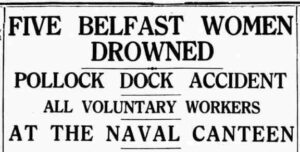
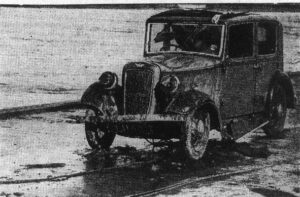 Just after 11pm on 29th February 1940, Captain Frederick FitzCurrie Trench, a volunteer worker at the club, bade goodnight to five female volunteers who had been on duty since 5:30. He saw them climb into an Austin 10 cabriolet car and heard the engine starting before he went back into the club to finish tidying up and to secure the premises. It was the last time that the women were seen alive. When the women failed to turn up at their respective homes, the alert was raised, and a search was instigated by Captain Trench. The following morning, the police noticed traces of oil on the water and a diver was called in to investigate. James Trainor from Fortingale Street located the car with its radiator embedded in the silt at the bottom of the dock and the vehicle was removed with the assistance of a crane. It seems that, as the car was being driven off in the blackout with minimum lights on the vehicle, the driver took a wrong turn and the car plunged into twenty feet of water in the dock.
  There were four bodies clasped together inside the car but the body of the fifth lady could not be located. The missing body was recovered on 3rd April, approximately fifty yards from where the car had entered the dock. The owner/driver of the car is not recorded in any of the newspaper articles relating to the incident or the Coroner’s Enquiry.
Mr E R Stephens, Honorary Secretary and Treasurer of the Missions to Seamen, received messages of sympathy from the Duke of Abercorn, Sir Crawford McCullagh (Lord Mayor of Belfast), and Lord Craigavon. The latter said, “I have been deeply shocked to learn of the most distressing accident involving the death of five ladies, who, with such patriotism and self-sacrifice, had ministered to the comforts of our brave sailors at the Pollock Dock Canteen. They lost their lives while serving their country and their names will be held in honoured remembrance by us all.”
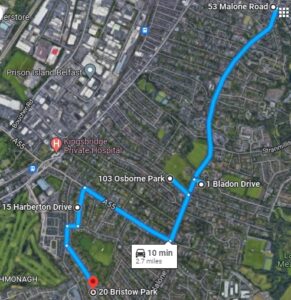 A Coroner’s Enquiry was held by Doctor Herbert Perry Lowe, City of Belfast Coroner, on 6th March 1940 and the solicitor acting for the Glass family was critical on the lighting restrictions. Mr George Leitch said, “Northern Ireland was miles away from the seat of hostilities, the lighting restrictions were stricter here than in cities and towns thirty miles from the Western Front. This tragedy should impress on the authorities the necessity for some alleviation in the lighting restrictions.” Doctor Lowe said, “of all the tragedies associated with the black-out he did not think they had one more tragic than this one.”
Captain Trench, who had served with the Army Service Corps and the Tank Corps in the Great War, volunteered at the canteen five afternoons and two or three evening a week. When on duty, he was in charge of the club and the other volunteers.
The five fatalities all lived in the Malone area of Belfast, four are buried in Belfast City Cemetery and one is buried in Dundonald Cemetery.
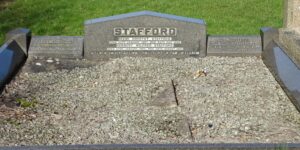 Mary Gorman Stafford was born on 11th May 1877 at St Stephen’s Green in Dublin to Reverend William Gorman, a Methodist Minister, and Mary Smallman Sibthorpe. The Reverend William Gorman ministered in Dublin, Cork, Limerick, and Belfast and has been described as “the prince of Irish Methodist preachers”. Mary Gorman married Frederick Stafford on 1st March 1898 at Balmoral Methodist Church (which was also known as Osborne Park Methodist Church), and they were members of the congregation for the rest of their lives. Frederick Stafford died on chronic nephritis on 29th June 1937 at the Rosapenna Hotel in Carrigart, Donegal. Like her husband, Mary Stafford was on the Board of Directors of J J Stafford & Sons, wholesale boot and shoe factors, of Union Street in Belfast and she also did voluntary work for the Voluntary Aid Detachment at the South Belfast Hospital Supply Depot. Mary Stafford as living at 1 Bladon Drive when she died at the age of 62 and is buried in the Stafford family plot in the Glenalina Extension of Belfast City Cemetery on 4th March. Her funeral was attended by the Reverend J E C Lawlor, Chaplain of Belfast Port, and Rear Admiral King. Mary Stafford left effects amounting to £4,117 eleven shillings and eightpence (approximately £245,261 in current terms) to her second son, Malcolm Ashman Stafford (Company Director) of Shrewsbury Drive in Belfast.
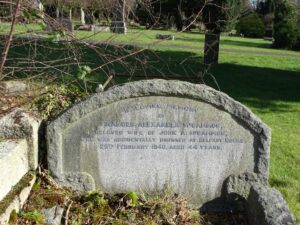 Frances Alexander McCammon was born on 12th August 1895 at Belmont Road in Strandtown to Richard Whytstock Leslie, a Medical Doctor, and Rosa Scott Alexander. Frances Leslie married John McCammon, a soldier, on 14th August 1919 in Belmont Presbyterian Church. John McCammon was a Manager with John Shaw Brown & Sons (Damask Linen and Handkerchief Manufacturers) of the Ulster Works on Dublin Road and Marcus Ward Street. Frances McCammon was a founder member of the Women’s League of Health and Beauty in Belfast. The family home was at 103 Osborne Park when Frances died at the age of 44. She is buried in Belfast City Cemetery and was survived by her husband and her daughter, June.
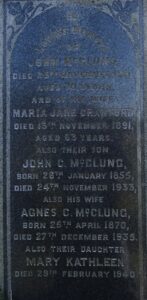 Mary Kathleen Jefferson was born on 18th July 1895 at Salisbury Avenue in North Belfast to John Cunningham McClung, a Linen Salesman, and Agnes Martha Currie. She took an active part in canteen work during the Great War and was later Honorary Secretary of the Duncairn-Clifton Women’s Unionist Association. Mary McClung married Frederic Jefferson on 25th August 1927 at Belfast Registrar’s Office and was living at 20 Bristow Park when she died at the age of 44. She was buried in the McClung plot in Belfast City Cemetery on 5th April 1940. The Right Reverend Doctor James Haire, Moderator of the Presbyterian Church in Ireland, the Reverend J E C Lawlor, Missions to Seamen, and the Reverend Alexander Lyle Harrison, Fortwilliam Park Presbyterian Church, officiated at the funeral. The Earl of Kilmorey and Rear Admiral King represented the Royal Navy. Mary Jefferson was a member of Fortwilliam Park Presbyterian Church and the Reverend Harrison said that he had made an appeal for books and magazines for the club on the Sunday before the tragedy and was to have handed them to Mrs Jefferson on 1st March. He said he felt that the five ladies were all victims of the war.
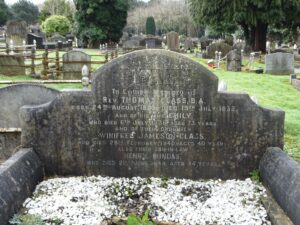 Winifred Jameson Glass was born on 14th June 1899 in Cooktown to Reverend Thomas Glass, Minister of First Cookstown Presbyterian Church, and Emily Wilson. Winifred Glass grew up in Australia as her father had accepted a call from a congregation in Melbourne. Following his death, she returned to Northern Ireland with her mother and was living at 53 Malone Road when she died at the age of 40 and was buried in Dundonald Cemetery on 4th March. She was an excellent golfer, being a member of Malone Golf Club.
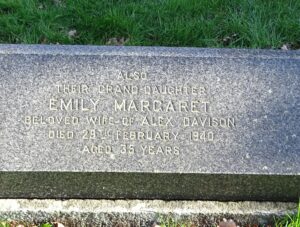 Emily Margaret Davison was born on 31st August 1904 at Eia House on the Antrim Road to John Smith Morrow, a Medical Doctor, and Mary Mathers McLaughlin. Her maternal grandfather was William Henry McLaughlin, the founder of McLaughlin & Harvey, a construction company. The Morrow family was living at Malone Park when Emily Margaret married Alexander Davison on 12th September 1928 at Malone Presbyterian Church. Alexander Davison was the Managing Director of the Grove Weaving Company and Chairman of the Irish Power Loom Manufacturers Association. Emily Margaret Davison was on the Board of Governors of Ashley House School and was an active member of the Royal Maternity Hospital’s “Gleaners Committee”, which had been formed in August 1933 to further the interests of the hospital. The family home was at 15 Harberton Drive when Emily Davison died at the age of 35 and she was buried in the McLaughlin family plot in Belfast City Cemetery on 4th March. Amongst those attending the funeral were Mr E H Stephens, Missions to Seamen, and Rear Admiral King. Emily Margaret Davison was survived her husband and three children, aged five to eleven.
Written by History Hub Ulster Member Nigel Henderson

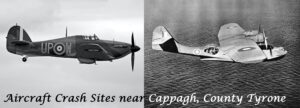
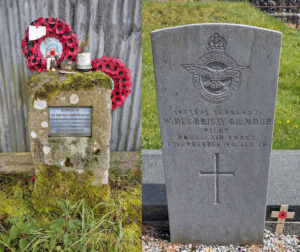 In 1941, Sergeant William Des Brisay Gilmour (Royal Air Force Volunteer Reserve) was stationed at RAF Ballyhalbert with 504 Squadron. On 23rd October 1941, he had flown a Hawker Hurricane aircraft (Serial Number 25204) to his maternal grandmother farm near Cappagh. He was performing aerobatics when he crashed the aircraft and was killed, aged 20. Sergeant Gilmour is buried in the Kyle family plot in the graveyard at St. Eugenius’ Church of Ireland in Cappagh. William Des Brisay Gilmour was a son of Dr George Van Barneveld Gilmour and Sara Johnston Gilmour (nee Kyle) and his birth was registered in Quarter 1 1921 at Brentford, Oxfordshire. The Gilmour family home was at 25 Ormond Road in Rathmines, Dublin, when William died.
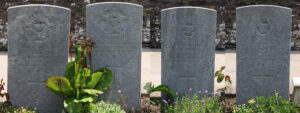
 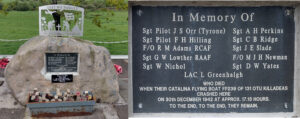 Sergeants Orr and Hilling were the pilots of a Consolidated PBY Catalina aircraft (Serial Number FP239) that took off from the RAF Killadeas on a daylight operational flying exercise on 30th December 1942. The weather conditions deteriorated earlier and more severely than forecast, and the aircraft crashed into a forested area at Deer’s Leap on Reaghan Hill near Omagh during a snowstorm, with the loss of all eleven crewmen. Four of the fatalities were buried in Northern Ireland and seven bodies were repatriated to Great Britain for burial.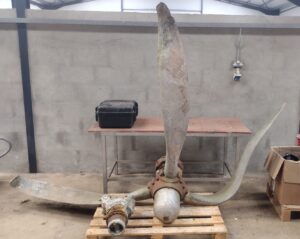


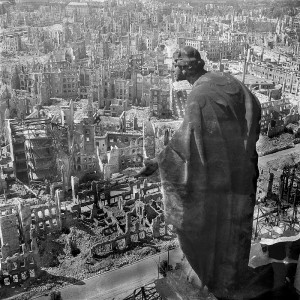 ed States Air Force report defended the operation as the justified bombing of a military and industrial target, which was a major rail transport and communication centre, housing 110 factories and 50,000 workers in support of the German war effort. Several researchers have claimed that not all of the communications infrastructure, such as the bridges, were targeted, nor were the extensive industrial areas outside the city centre.
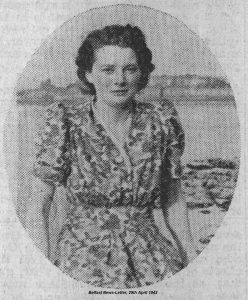 During an air raid in May, Auxiliary Nurse Denise Forster (21) was on duty at the Ambulance Depot on the Holywood Road when it was demolished by a high explosive bomb.
 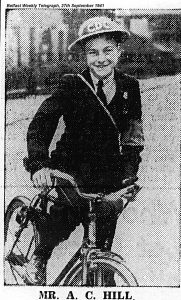 Messenger Alexander Cecil Hill (17), an office assistant from Convention Street, received the BEM. Although severely shaken by an explosion nearby, Alexander directed traffic at a main road whilst bombs were falling nearby. Later, whilst delivering an urgent message to the Report Centre, he was blown off his bicycle by explosions twice but each time he remounted and delivered the message.
 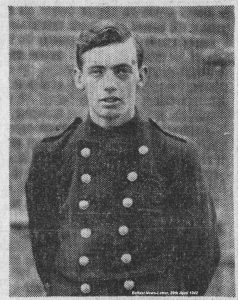 BEMs were awarded to Bomb Identification Officer William John Ford (51) and Messenger William Ernest Bennett (15) of Wandsworth Gardens for rescue work at Cliftonville Road where bombs had destroyed a number of houses and fractured a gas main. Ford and Bennett burrowed six yards through rubble to bring an elderly man to safety and then they rescued two stranded women from a house that was in danger of collapse. Bombs were falling as they worked and both suffered from the effects of inhaling coal gas. William Bennet later joined the National Fire Service.
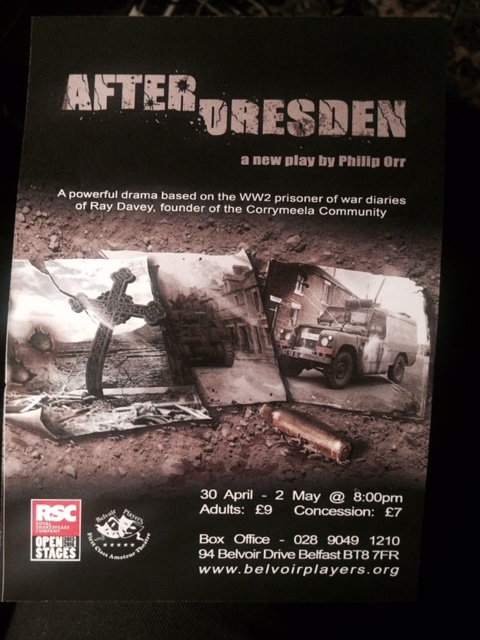 Shrove Tuesday 1945, Allied planes drop bombs on Dresden, killing thousands of people, most of them believed to be civilians and refugees.