Homes for Disabled Heroes – The Occupants. Please note this is part two of an article. You can find part one by clicking here.
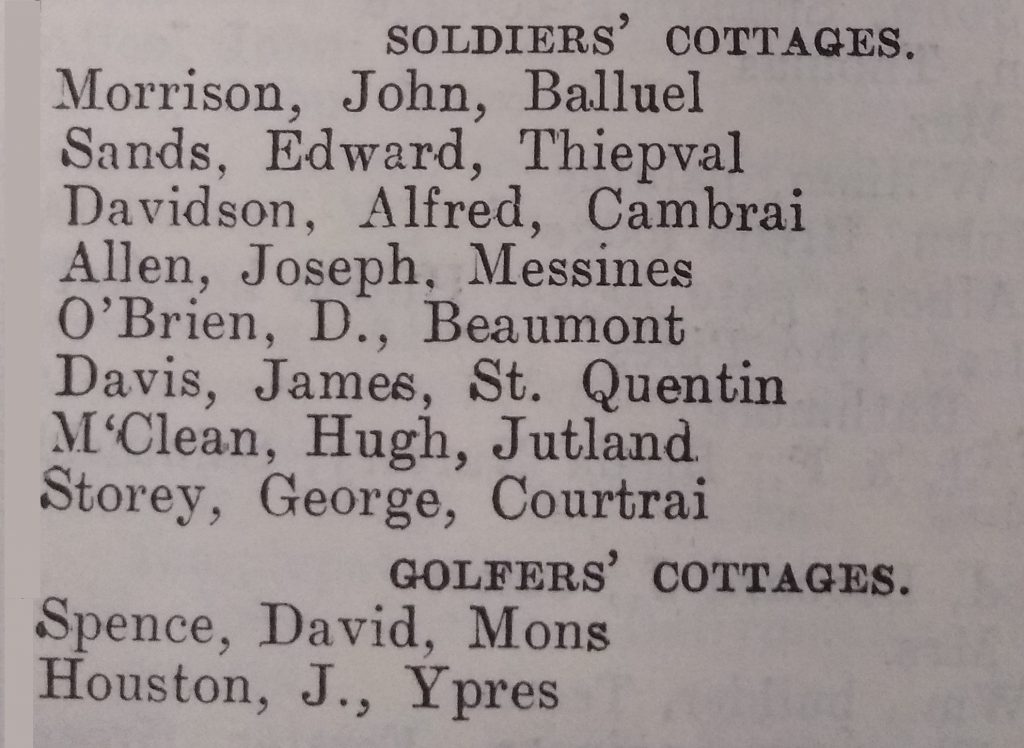
Thiepval Cottage
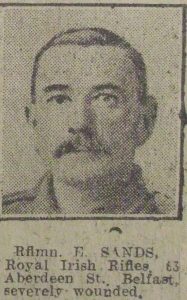
Sands, Edward, Rifleman
Edward Sands was born on 25th January 1879 at Drumnagally near Banbridge to Samuel Sands, a Bleacher, and Isabella Sands (nee Morrow). He married Mary Gilmer on 13th December 1899 at St Anne’s Parish Church in Belfast. In 1901, Edward and Mary were living at Seventh Street with Edward’s paternal grandfather. By 1911, Edward and Mary were living at Aberdeen Street with their ten-year-old son, William. Edward was a 35-year-old joiner at a mill and a member of the West Belfast Regiment UVF when he enlisted with 9th Battalion Royal Irish Rifles on 9th September 1914, being made a Lance-Corporal on 11th September 1914. He was deployed to France in October 1915 and was transferred to 2nd Battalion in February 1918. On 21st March 1918, during the Battle of St Quentin, he sustained gunshot wounds to his left arm and a compound fracture of his left leg and was admitted to 41st Casualty Clearing Station. He was moved to No 3 Stationary Hospital where the affected limbs were amputated. Following hospital treatment, he was invalided to the United Kingdom on 3rd May 1918 on board HMHS Carisbrook Castle. He was finally discharged from the Army on 9th November 1920, by which time he was living at Thiepval Cottage at Knockbreda. Edward Sands, who is commemorated on the Roll of Honour for the Shankill Road Mission, died on 21st August 1949, aged 70, and was buried in the graveyard at Scarva Street Presbyterian Church in Banbridge on 24th August. His widow was living at Breda Road in Belfast when she died on 22nd January 1965 and was laid to rest alongside her husband.
Cambrai Cottage
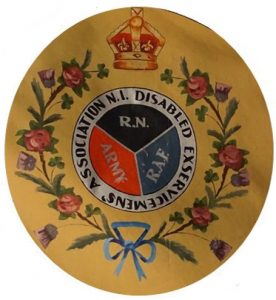 Alfred Ernest Davidson was born on 7th May 1886 at Upper Townsend Street to John Davidson and Mary Elizabeth Davidson (nee Malcolm). Alfred, an insurance agent, was living at Chatsworth Street in the Pottinger Ward when he married Elizabeth Cherry on 13th January 1909 in St Clement’s Parish Church on Templemore Avenue. They were living at McClure Street in the Cromac Ward in 1911. Alfred enlisted with the Royal Dublin Fusiliers on 24th June 1916 and served on the Western Front with 1st Battalion, being badly wounded in the Cambrai sector on Christmas Eve 1917. His wounds necessitated the amputation of both legs and his right arm. Alfred was discharged on 24th October 1918 with Silver War Badge Number B32162 and received a Constant Attendance Allowance. He was a member of the British Limbless Ex-Servicemen’s Association and a founding member of the Disabled Ex-Servicemen’s Association in Northern Ireland, whose colours are housed in Sinclair Seamen’s Presbyterian Church. He was chairman of the latter association throughout the 1950s. He died on 29th November 1967, aged 81, and his funeral was conducted at the Church of the Pentecost on Mount Merrion Avenue to Knockbreda Cemetery.
Messines Cottage
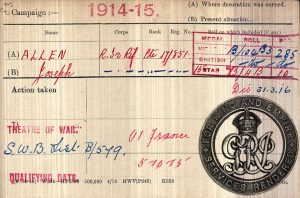
Allen, Joseph, Medal Index Card
Joseph Allen was born on 1st April 1870 at Linwood Street in Belfast to Samuel Allen, a cloth finisher, and Martha Allen (nee Andrews). Joseph Allen was living at Keswick Street when he married Agnes Doherty from Brookmount Street on 1st April 1907 at the Holiness Movement Church on the Crumlin Road at Ballysillan. In 1911, they were living at Sixth Street with their first child, Samuel (born 1908). They had four more children – Joseph (1911), Elsie (1912), Pearl (1914), and Martha (1916). Joseph Allen was 36 years old when he enlisted with 17th Battalion Royal Irish Rifles on 25th May 1915 and was deployed to France with 9th Battalion in October 1915. In early January 1916, Agnes Allen received a telegraph message advising her that Joseph was dangerously ill having been admitted to 9th General Hospital in Rouen with gunshot wounds to the spine. The telegraph also advised that she could visit at public expense. As Agnes Allen was six months pregnant and had four children under the age of eight, the last being born in March 1914, it is doubtful that she would have been able to travel to France. Joseph Allen was discharged due to his wounds on 31st March 1916 with Silver War Badge Number 304101 and was awarded a pension of twenty-five shillings per week (£122 in current terms) the following month. He was living at Avondale Street when he received the King’s Discharge Certificate in December 1918 and was one of the first two occupants of the Soldiers Cottages at Galwally in April 1919. In 1921, his army pension was reduced to twenty shillings per week (£43 per week in current terms). Joseph Allen died in Messines Cottage on 12th September 1939, aged 60, and is buried in Dundonald Cemetery.
Beaumont Cottage
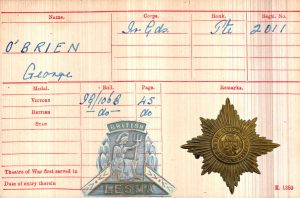
O’Brien, George, Medal Index Card
Entries in Belfast Street Directories record O’Brien, D but death notices identify the occupant’s forename as George. George O’Brien was born in Liverpool to John O’Brien, a bootmaker, and Caroline O’Brien (nee Wilson) and was baptised on 28th December 1879 at St Titus’ Church in Liverpool. The family was living at Solway Street in 1901. George was an Iron Moulder in a Belfast shipyard when he married Sarah Anderson on 22nd December 1909. In 1911, they were living at Susan Street in Pottinger Ward, with their daughter, Edna (born 9th August 1910) and George’s widowed mother. George was serving on the Western Front with 1st Battalion Irish Guards when he was admitted to hospital with trench foot on 17th March 1917 and transferred to Sick Convoy on 27th March. He was discharged on 3rd February 1920 and was living at 147 Newtownards Road when he was awarded a 100% Disablement Pension in respect of a double amputation. The pension was paid at the rate of forty shillings per week with an additional allowance of twenty-nine shillings and sixpence for his wife and three dependant children, which equates to £170 per week in current terms. George, a member of the Limbless Ex-Service Men’s Association, died at Beaumont Cottage on 13th November 1931 and is buried in Dundonald Cemetery.
St Quentin Cottage
James Davis was a son of James Davis, a carpenter, and Margaret Davis (nee Browne) and the family lived at Collyer Street. In 1911, James Davis was a labourer in a tobacco factory and was already in the army when he married Sarah Briggs of Gertrude Street on 24th December 1915 at Newington Presbyterian Church. Unfortunately, I have not been able to identify further details about his war service. James Davis died suddenly on 5th June 1977 at Crossfields House, the Royal British Legion Home at Brecon in South Wales
Jutland Cottage
Hugh Joseph McClean (sometime McLean) was the occupant of this cottage in 1926 but he later lived at Mons Cottage. He was born on 5th January 1892 at Main Street in Strabane to Charles McLean, a butcher, and Catherine McLean (nee Patton).On the night of the 10th December 1930, Hugh Joseph McLean was found, badly injured, on Church Road and was taken to the Royal Victoria Hospital where he died on 11th December 1930, without regaining consciousness. The newspapers reported that Hugh was a Naval pensioner who had been injured in the legs at the Battle of Jutland and could only walk with the aid of two walking sticks, which were found 300-400 yards from the body. It was assumed that Hugh McLean had been knocked down by a motor car and, despite police appeals, the perpetrator was not identified. Hugh Joseph McLean was 37 years old and is buried in Milltown Roman Catholic Cemetery.
Courtrai Cottage
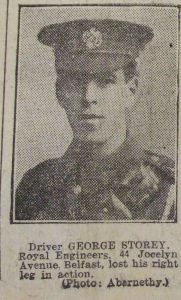 George Shiels Storey was born in Liverpool on 16th July 1893 to George Storey, an Iron Turner, and Mary Ellen (nee Shiels) and was baptised on 15th October 1893 at St. Matthias’ Church. The family had moved to Belfast by 1897 and was living at Roslyn Street in the Ormeau Ward in 1911 and had moved to Jocelyn Avenue by 1917. George Storey enlisted as a driver with the Royal Engineers on 7th January 1915 and was deployed to the Western Front after 31st December 1915. On 7th February 1917, he sustained shrapnel wounds and a fracture of the right tibia and was transferred to No. 18 Hospital train on 15th November for evacuation to Ireland. On 20th November 1917, the Northern Whig reported that George’s right leg had been amputated. He was serving with 227th Field Company when he was discharged on 20th February 1919 due to sickness with Silver War Badge Number B200373. He was living at Jocelyn Avenue when married Charlotte McCarthy (nee Dalzell) of Boyne Street on 26th March 1919 at Knockbreda Parish Church. The 1924 Belfast Street Directory records him as the occupant of Ypres Cottage. George and Charlotte Storey were living at Courtrai Cottage when George died at the UVF Hilden Hospital at Galwally on 5th June 1927, aged 33. He was buried in Knockbreda Cemetery and death notices were placed by Ballynafeigh Guiding Star LOL 597 and two RAOB lodges with military associations – Sir Henry Wilson Memorial Lodge and Lord French Lodge.
 Mons Cottage (Golfers’ Cottages)
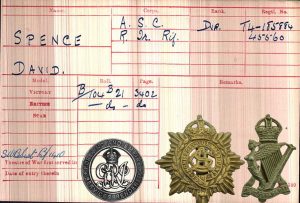
David Spence was born on 17th October 1895 at Ambleside Street to David Spence, a storeman and later a draper’s traveller, and Margaret Spence (nee Johnston). The family was living at Ballymena Street in Clifton Ward in 1901. In 1911, David was an apprentice barber and living with the Finlay family at Silvio Street, along with his grandmother, Ellen Johnston. David Spence was working as a vanman and living at Matchett Street when he enlisted with the Army Service Corps on 5th May 1916 at the age of 22, naming his grandmother, Ellen Johnston, as his next of kin. He was deployed to France on 8th June 1916 as a driver but was transferred to 1st Battalion Royal Irish Rifles on 13th September 1917. David Spence was taken prisoner on 21st March 1918 during the Battle of St Quentin and, on being repatriated, he was admitted to the 1st General Hospital at Camberwell on 18th August 1918, where his right leg was amputated at the thigh. On 13th September, he was transferred to the UVF Limbless Hospital in Belfast where had a mechanical limb fitted and was discharged as an invalid on 21st September 1919, having been discharged from the army on 19th September 1919 with Silver War Badge Number B306962. David Spence’s disablement was classified at 80% and his character was recorded as “Very Good”. David Spence was living at Matchett Street when he married Annie Hall (nee Cook) of Mourne Street on 24th December 1919 at Belmont Presbyterian Church. In 1951, David Spence was living at Jutland Cottage and was living at 6 Church Road (Mons Cottage) when he died on 16th December 1971.
Ypres Cottage (Golfers’ Cottages)
Robert Houston was an electrician employed by James Barry and Company of Church Street when he enlisted with the Royal Irish Rifles on 7th September 1914 and was deployed to France with 8th Battalion in October 1915. On 15th July 1916, the Northern Whig reported that he had been wounded and was in a hospital in Devon. Robert Houston was a brother of Mrs Ritchie of 23 Magdala Street. On 10th May 1917, the Belfast News-Letter reported that Robert had been seriously wounded. Robert Houston was discharged on 10th October 1919 with Silver War Badge Number B323307, having had both arms amputated below the elbow. In April 1954, he was given a television by the King’s Fund via the Ministry of Pensions.
Notes:
These houses are being documented and their occupants researched by History Hub Researcher, Nigel Henderson, and progress can be followed in this Facebook group – https://www.facebook.com/groups/204334820682671/
If readers have any old photographs of the cottages covered by this article or have any information about the men who lived in any of the cottages built for veterans of the Great War, History Hub Ulster and Nigel Henderson would like to hear from you. You can contact us by email or via the Facebook group.
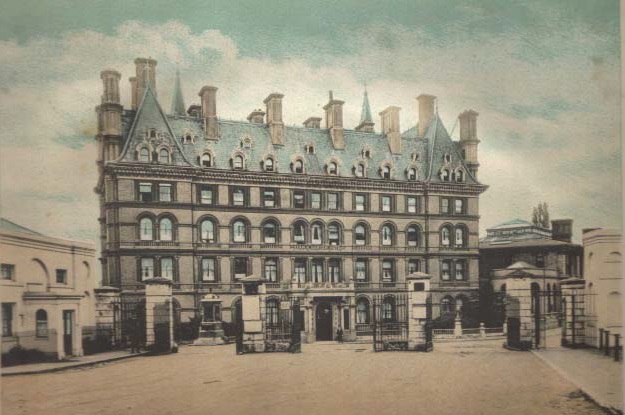
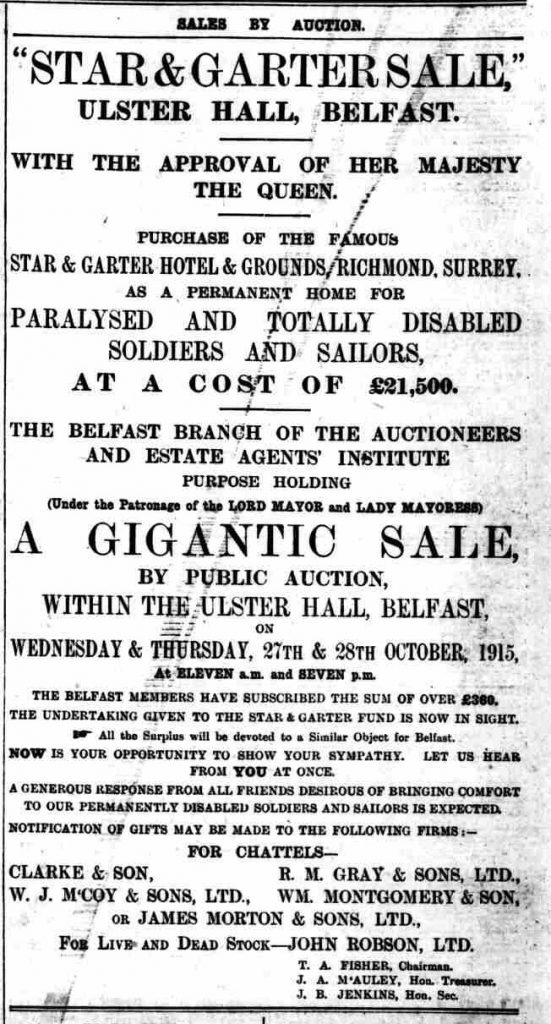
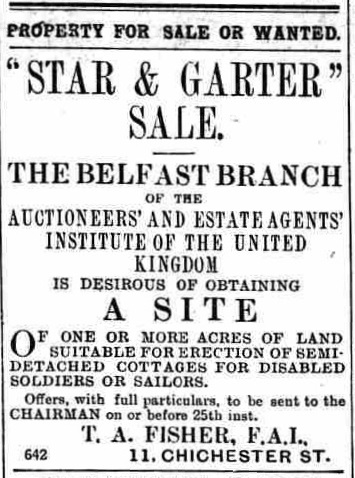
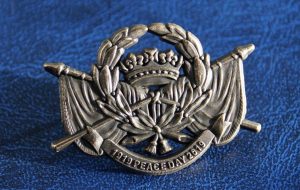
 Following the Great War Armistice signed on 11th November 1918 various peace treaties were signed during 1919. These culminated in a series of ‘Peace Rally’s’
  Cost is as follows. Postage will be by 1st class.
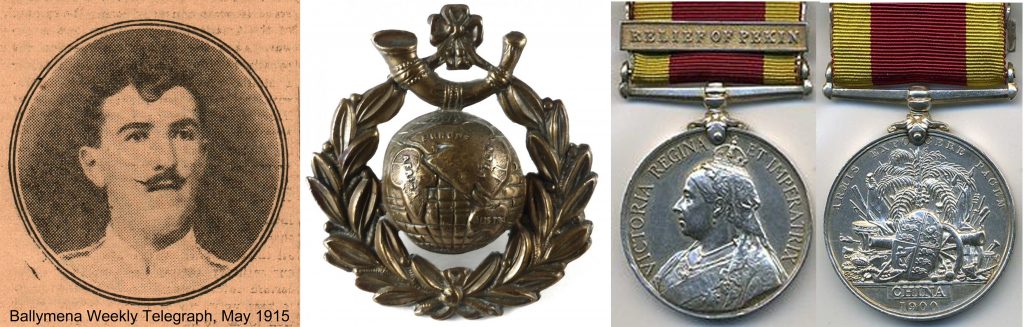 This article commemorates the memory of Lance-Corporal Hugh McNeill of the Royal Marine Light Infantry who died on 21st June 1918, 100 years ago today.
 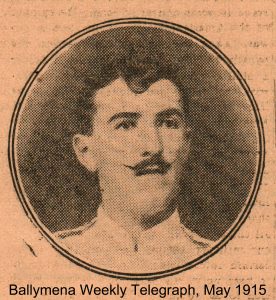 According to naval records, Hugh McNeill was born in Belfast on 5th January 1881. Hugh enlisted on 7th July 1899 and served in the crushing of the Boxer Rebellion (10th June to 31st December 1900) in China, for which he was awarded the China War Medal (1900). He subsequently served on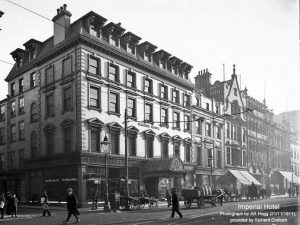
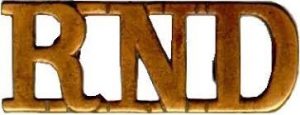
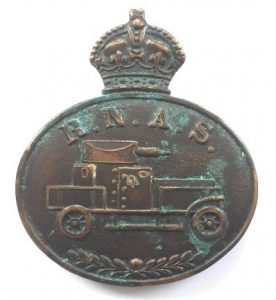 Hugh McNeill then served with a Royal Naval Air Service’s Armoured Cars unit under Commander Charles Rumney Samson RN between 10th September 1914 and 17th October 1914 before returning to the Royal Naval Division. Following a period of furlough, an interview with Hugh McNeill was published in the Ballymena Weekly Telegraph in May 1915 in which he spoke highly of the “pluck and daring” of Commander Samson, particularly in engagements with roving units of Uhlans (Light Cavalry, with a Polish military heritage), saying that, “the Germans had come to greatly dread and fear Commander Samson and his gallant men”.
 As early as February 1915, local newspapers reported that 150 artillery pieces captured from the Germans were in London and that they would be presented to districts, “which had done good work in the cause”, after the war. However, during the period of the war some war trophy guns were displayed in locations in the north of Ireland – two machine guns captured by the Ulster Division were sent to Londonderry (November 1916) and Portadown (July 1917) and a field gun was on temporary display in Belfast in 1916.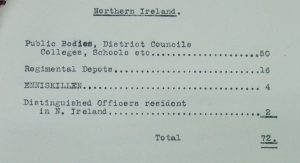
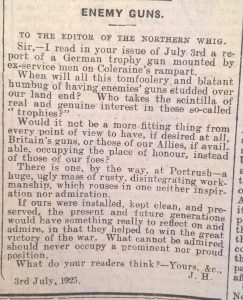
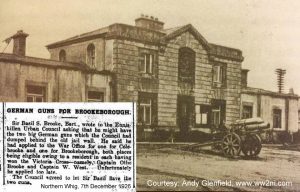 In March 1925, the Northern Whig reported that Enniskillen Urban Council had removed the German gun from the Diamond and the same newspaper reported, in December 1926, that the two guns outside the gaol were, “to be placed at the rear of the old gaol (out of the public view)”. In September 1927, the Belfast News-Letter reported (see inset) that Sir Basil Brooke had written to Enniskillen Urban Council requesting the guns for Colebrooke House and Brookeborough. The Colebrooke House gun has been on display at Enniskillen Castle since February 1976.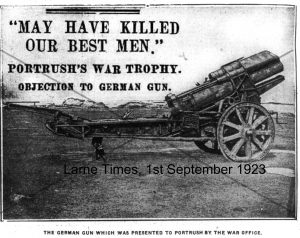
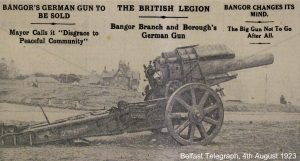 On 2nd October 1935, the Belfast News-Letter reported that Bangor Borough Council had decided to sell the Kingsland trophy gun for scrap, a decision which incurred the wrath of the Bangor Branch of the British Legion, which submitted a letter of complaint. The council subsequently reversed its decision.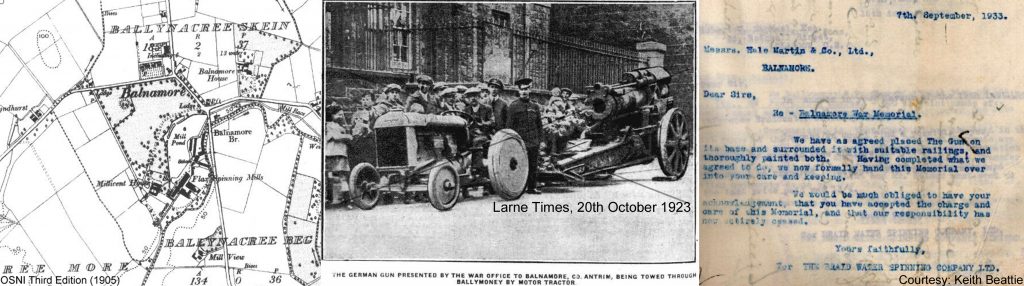
 The Northern Whig and the Belfast News-Letter both reported on discussions in the council chamber concerning the gun. Mr Robert McAfee expressed the opinion that “the town Ballymoney was deserving a better trophy. lt is 32 years ago since it was manufactured, and I question whether it was in the late war at all. It is like a piece of down pipe of spouting set on two wheels”. The field gun was placed on a pedestal in the small green at the Town Hall.
 In Omagh, there was opposition from Nationalist councillors on the urban council to the trophy gun that was to be sent to the town by the War Office. In March 1923, Mr Orr spoke in favour of receiving the guns, saying that, “this was a matter above party or politics, as the men of their local regiment, the Royal Inniskilling Fusiliers, of which they were proud, belonged both to the Orange and Green flag”. Two months later, the Mid-Ulster Mail reported on the ongoing wrangle between rival councillors. Mr McLaughlin said, “the council should never have considered the question of taking the gun at all, as the feeling of the majority of the members was totally against”.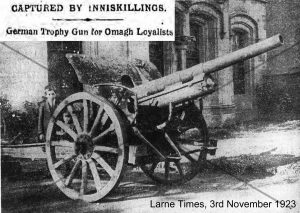
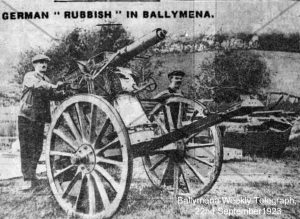 In October 1923, the Ballymena Observer reported that the German guns sent by the War Office to Ballymena had not received a fulsome welcome by Ballymena Urban District Council. The Clerk said the guns they had received – one howitzer and one Maxim – were not suited to the importance of the town. They had been promised two field guns and a machine gun but had only received one field gun and a machine gun. The Chairman remarked, “if we are to have war trophies for the Memorial Park let them be something presentable. Other towns of much less importance than Ballymena have been able to secure something better than derelict German machine gun for their Parks”. One of the councillors, Mr Craig, went further saying, “What do we want with them, a lot of German rubbish?”.
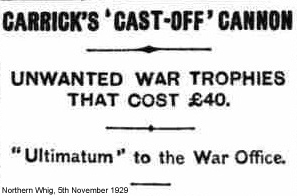 Carrickfergus Urban District Council had requested two field guns and two trench mortars. However, the War Office offered a heavy field gun, a field gun and a machine gun but sent two heavy guns. These guns lay in the London Midland & Scotland Railway Company’s yard in Carrickfergus until 1929. Although they were never put on public display, the council spent £40 cleaning and painting the guns. In November 1929, the LMS Railway notified the council that the guns had to be removed within two weeks, prompting the council to send an ultimatum to the War Office stating that, “unless Carrick is relieved of its cannons they would be sold as scrap”. On 3rd December 1929, the Northern Whig reported that the council had accepted a tender of £12 [approximately £700 today] from O & T Gallagher of Corporation Street in Belfast.
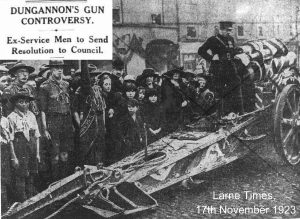 In Dungannon, the trophy gun was pulled into position outside the British Legion’s new club premises for the Armistice Day commemoration in 1923. Six years later, due to bus traffic, the gun was moved from Market Square to a position overlooking the ex-Servicemen’s houses on Empire Avenue. In late 1937, Dungannon Urban Council considered a proposal to sell the gun for scrap, but this met with opposition from the British Legion and ex-Servicemen, who decorated the gun with a Union flag and a notice declaring “Not for Sale Lest We Forget”. There is still a German field gun on display in the park on Black Lane, the site of Dickson’s Mill. The information panel at the site records that the gun had been purchased by the Dickson family at an auction of military artillery in the south of England in 1920.
 A list of the locations in Northern Ireland that received trophy guns is contained in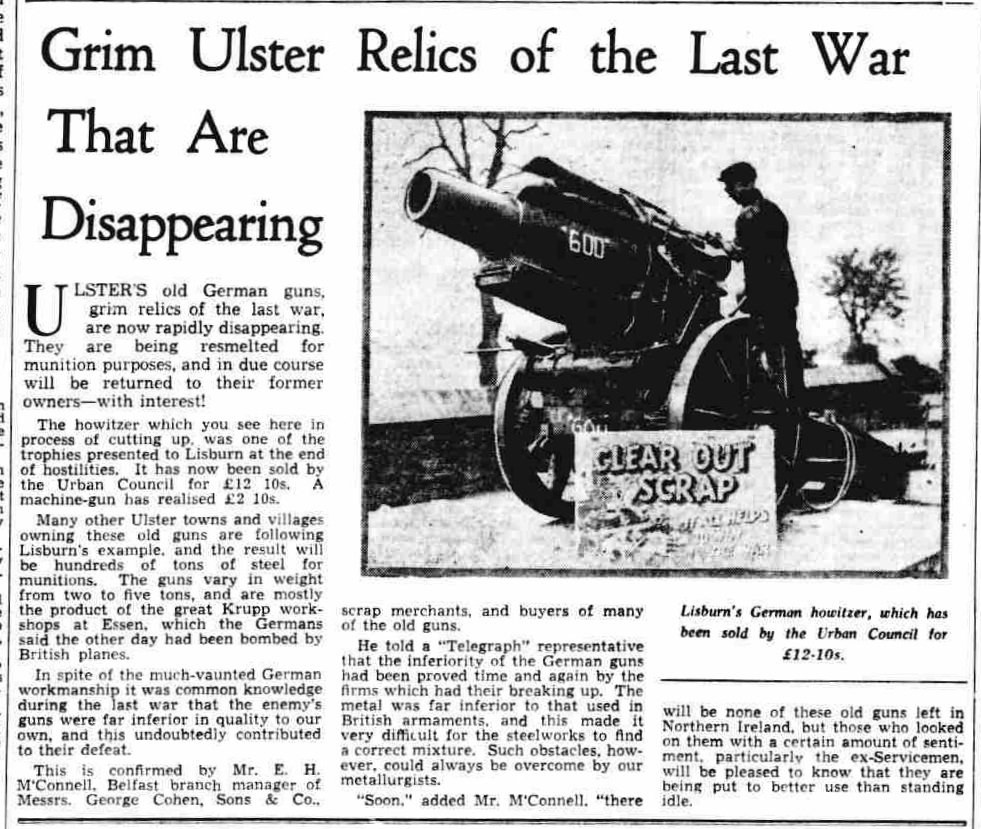

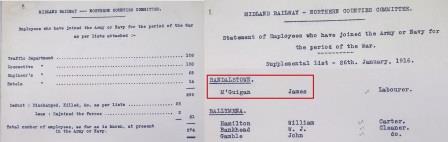 James McGuigan had initially joined a reserve battalion of the Connaught Rangers but was deployed to the 8th Battalion Royal Inniskilling Fusiliers in France. As with Benjamin Anderson, James McGuigan died during the 1916 Battles of the Somme, being killed in action with the 16th Irish Division on 9th September 1916 during the Battle of Ginchy. James Joseph McGuigan was born at Albert Street in Belfast on 4th June 1879 to Patrick McGuigan and Catherine Ahern and he married Mary Drain at the Roman Catholic Chapel in Randalstown on 29 December 1906. James and Sarah were living at Drumsough in Sharvogues in 1911 and they had seven children, the first child (Peter) being born in May 1907 and the last child (Lizzie) being born in March 1915.