Belfast & County Down Railway (BCDR) – Drumhirk Ballast Quarry, Newtownards
Guest post by Ken Sims
Background
From its inception in 1848 the Belfast & County Down Railway (BCDR) initially ran lines from their terminus at Queens Quay, Belfast to Holywood and in 1850 to Church Street, Newtownards via Comber. During the late 1850s what was to become the main line was extended from Comber to Downpatrick and would eventually extend to Newcastle and Castlewellan.
It was decided in 1861 to extend to Donaghadee what had by then become a branch line from Comber to Newtownards. In Newtownards the station at Church Street was replaced by a new one at Victoria Avenue with further stations beyond at Conlig, Ballygrainey and Millisle Road, Donaghadee. The main Station at Donaghadee was beside the harbour and eventually a siding line was opened to serve the pier mainly for coal imports.
At the outset of the planning for the extension to Donaghadee, one of the main infrastructure challenges for the Dublin-based engineers J&R Edwards, was a deep rock cutting required at Drumhirk north east of Newtownards on the way to Conlig. Locally this feature would be (and still is) known as Jack’s Cutts.
From 1876 a siding at Hogstown outside Donaghadee was used for the storing of ballast stone. This function continued there until 1904 when BCDR decided to open a ballast quarry and siding at Drumhirk.
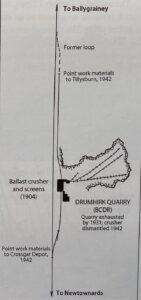
The quarry area measuring just under 8 acres would have been surveyed for suitable rock to be quarried for ballast stone. The rock identified is a blue whinstone dated to 400-450 million years, and may well have been initially identified as suitable when the cutting was developed prior to the opening of the extension in 1861.
Quarried rock would have been brought from the rockface in bogie wagons along small tramway tracks to an elevator positioned beside the siding. The contents of the bogies would then have been hoisted by an elevator into a crusher machine above the siding. The rock would have been crushed down to an aggregate of about 2 inches for use as track ballast. Trains would have brought empty ballast wagons into the siding and placed them under the crusher so that they could be filled and then distributed to the railways network.
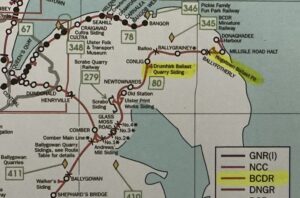
In December 1908, four years after the opening of the quarry and siding, the BCDR purchased the land in and around the quarry for the princely sum of £275 (including royalties).
During this early period output of the crushed stone was high, and at one point in 1906 there were 17 people employed at the quarry according to a report by the Inspectorate of Mines and Quarries. However, in this early period while output was high, with no health and safety (as we now know), between 1909 and 1911 several accidents took place causing injuries to workers. Thankfully there were no fatalities.
 Close by, further along the line at the Conlig level crossing, a fatal accident did take place in June 1912. Workers from the quarry were engaged to attend the accident site to help with removal of the bodies of the three victims to Newtownards.
In 1916 the Inspectorate of Mines and Quarries reported that there was just one person employed at the quarry. This was probably a holding or administrative figure as the quarry was inactive during the Great War due to labour shortages.
Following the war, the quarry became active again but activity was at a lower level. Throughout the 1920s tonnage output greatly reduced. At its peak in 1911 annual output had been as high as 23656 tons, but by 1930 that had reduced to just 260 tons. During 1931 production was exhausted and from then the quarry fell into disuse.
Eleven years later in 1942 it was decided by BCDR to finally abandon the quarry. The siding points and signalling equipment were lifted and relocated to Tillysburn and the Crossgar Admiralty Depot. The elevator, screens, gas engines and other items of equipment etc., that could be salvaged were auctioned or scrapped. The stone crusher (made by Broadbent of Stalybridge) was salvaged and taken away by a local quarry owner from Craigantlet, and was used there until it was scrapped in the 1990s. The attached image shows a typical size of unit (with added wheels).
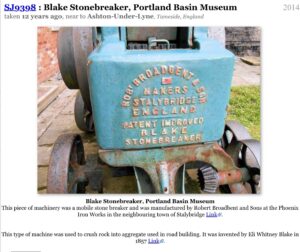
In 1950 the railway itself (by then owned by the Ulster Transport Authority (UTA)) was closed as indeed was the entire BCDR network with the sole exception of the Belfast to Bangor route.
The land containing the quarry was eventually sold off by the UTA in 1954, and eventually in 1967 it came into the ownership of the local council where it remains to this day.
Excavation
During 2024 and 2025 I wrote a series of posts for the Facebook group “Irelands Abandoned & Dismantled Railways” about the former Comber to Donaghadee branch line, featuring surviving remnants such as bridges, stream culverts, level crossings, embankments and cuttings just like this one at Drumhirk.
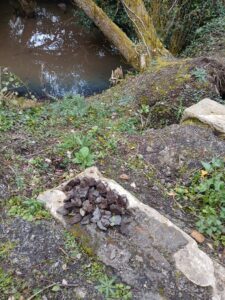
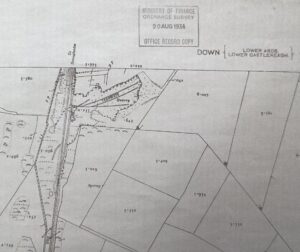
In the Spring of 2024, while first exploring the quarry area beside the railway cutting at Drumhirk, I began to unearth beneath my feet some of the concrete floorings and foundations of the quarry buildings just a few metres from the former trackbed. It took me 3-4 months to dig away all the undergrowth and overgrowth to expose the full extent of the floorings. The shape of the buildings is shown on historic Ordnance Survey maps, but as of yet no detailed plan of the lay out has been discovered.
Greenway
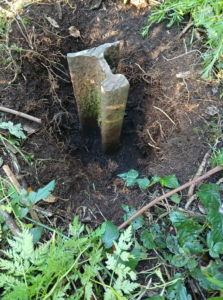
It is purely coincidental that during this time, plans for the development of a new greenway along this route had been undertaken by the local council. Ground was eventually broken in January 2025 and work is now complete on some sections including that at Drumhirk. The remnants of the quarry buildings will be just a few metres away from the greenway path.
This phase of the greenway links up with the existing Whitespots Country Park and Somme Museum by way of a new footbridge across the main A21 dual carriageway. It then progresses past a former overbridge beside the Ark Open Farm then along past the location of the former Conlig Station and on towards the end of the phase at Green Road.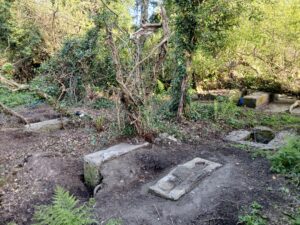
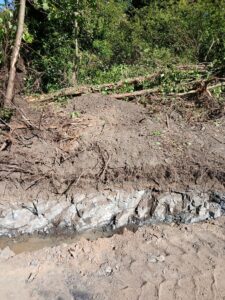
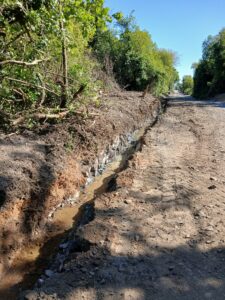
As part of the development of the Greenway the contractors dug out drainage channels along the side of the pathway beside the Drumhirk quarry, exposing a narrow seam of what appears to be the same rock as had been extracted from the quarry between 1904 and 1931.
 Conlig Station
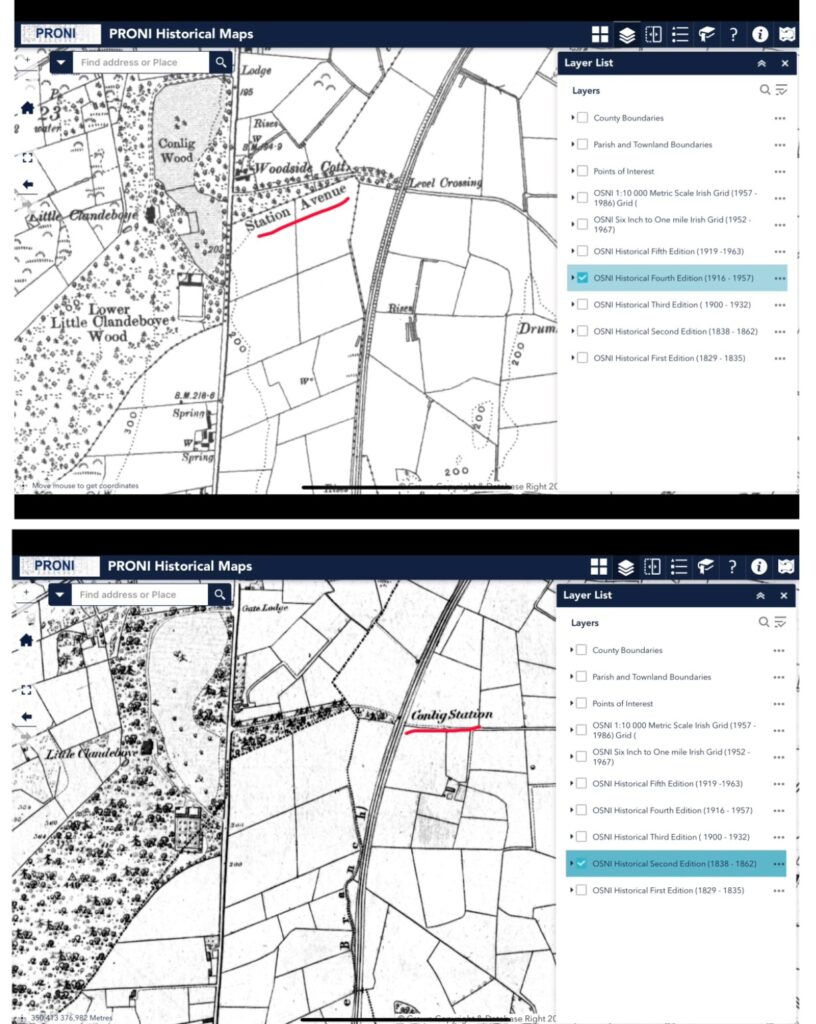
At the time of the opening of the Drumhirk Ballast Quarry in 1904 the closest stations were Newtownards and Ballygrainey near Six Road Ends. Several years prior to that, the short lived Conlig Station (1861-1873) was accessed from the main road at Conlig by way of Station Avenue. This was of course before the days of the dual carriageway. The station was located where the railway crossed what is now Drumhirk Way.
 It was closed in 1873 and continued as a crossing, and apparently until recently the concrete flooring of the station survived at the corner of the old crossing, although it will have now been overlaid with the new greenway path. As mentioned earlier this crossing was the location of the fatal accident in 1912.
Hopefully the new greenway will help raise the public’s awareness of our industrial past whether it be at Whitespots Lead Mines, Drumhirk Ballast Quarry and all the other surviving parts of the former Belfast & County Down Railway.
Ken Sims 2026