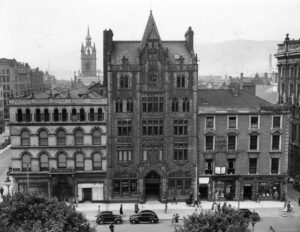
1903 Northern Bank
The large Northern Bank (now t/a Danske Bank) head office on Donegall Square West is not one of the most popular buildings in Belfast even though it won an architectural award in 1977 and was ‘listed’ in 2015.
Prior to the formal merger of the Belfast Bank with Northern Bank in 1970, the bank directors decided that two aging Victorian head offices, Waring Street and Victoria Street would be too small for the new business.
A corner block on Donegall Square West and Howard Street was considered to be the best location for a new head office building. Northern Bank already had a branch there but it was surrounded on both sides by a linen warehouse and two Georgian town houses. This 1903 branch had been designed by local architects, Young & Mackenzie.
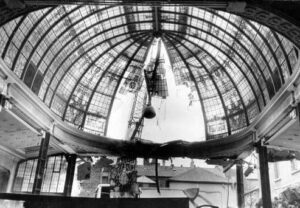
Demolition 1971
The old branch featured a glass dome over the banking hall. The destruction of this dome left only a few similar structures in Belfast; former Provincial Bank of Ireland, Royal Avenue; former Belfast Savings Bank, Arthur Street; former Northern Bank, Victoria Street and former Ulster Bank, Waring Street.
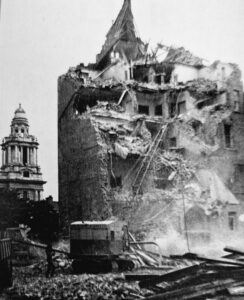
Demolition 1971
Demolition of the site started in 1971/72 with the last tenant moving out as neighbouring buildings were half demolished. Robert J Greenslade of Building Design Partnership and F B McKee & Co. Ltd. were appointed as architect and building contractors respectively.
Piling into the Belfast sleech and the subsequent building of the concrete basement slab proved to be the most difficult part of the contract. The bank project manager, J D Brown wrote afterwards;
“My first reaction was that with so many experts involved no doubt they would sort it out within a few days. It was not long before my confidence was shattered. A ‘few’ piles became a much larger number and it became clear that it would be a major operation to re-instate the situation. It was unfortunately not just a matter of driving in more piles. The result culminated in the formulation of a different technique designed to hold the piles firmly until they were finally anchored by the basement slab.”
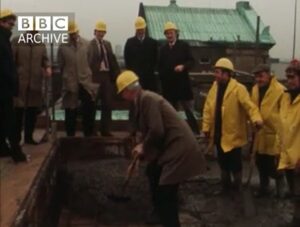
1975 Topping Out Ceremony © BBC
A 1971 press release mentioned 1973 as the opening date. However, civil disruption, strikes and a lack of skilled labour meant delays set in. The ‘topping out’ ceremony was reported on the BBC ‘Scene Around Six’ programme broadcast on 14th January 1975. J D Brown wrote:
“After all the trials it is a very considerable compensation that the results are promising to be very handsome indeed, and I believe that we are going to have a building, which will be quite a contribution to a city which has ample scope for more dignified and distinctive architecture.”
The portland stone clad building that emerged from the site can be seen to fit into the changing face of Donegall Square and its close relationship, both with the Scottish Provident building next door and the City Hall across the square greatly influenced the scale of the building.
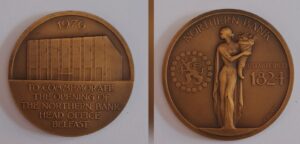
1976 Bronze Medals
The new Head Office opened on 9th August 1976 and staff were presented with a bronze medal designed by Paul Vincze, one of the world’s most eminent medallists.
Most of the departments that had previously been spread across the city were now housed on modern, open planned floors of the new building.
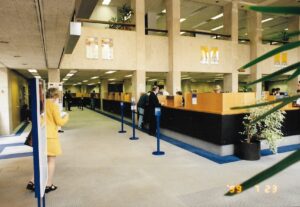
© David Chesterman
The architect, Robert J Greenslade, would later win a prestigious architecture award for the building.
The former Belfast Bank head office on Waring Street would become a Northern Bank branch until its later sale to a developer and the former Northern Bank head office on Victoria Street would later be sold to AIB / First Trust.
Branding on the building changed over the years. The Midland Bank ‘griffin’ was replaced in 1987 when National Australia Bank bought Northern Bank. A staff designed ‘causeway shaped’ logo lasted until 2004 when Danske Bank became the new owners with their redesigned branding coming in 2006.

Logos
Over the past few decades, the building has seen many changes, externally and internally. The rooftop garden attended by one of the bank messengers was removed and a stepped-back fifth floor was added. This was to avoid the building towering over the City Hall. As the bank consolidated its branches, back-end systems and merging of departments, one floor of the head office building was leased out to an external financial consultancy business.
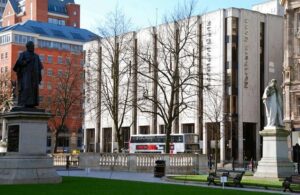
© geograph.org.uk
In late 2004, the building became the focus for one of the biggest news stories of that year and years afterwards. The bank’s underground ‘Cash Centre’ with an entrance on Wellington Street was robbed in a well-planned operation, allegedly by the IRA. Whilst little of the stolen money has been found, the bank made the decision to withdraw all its banknotes (bar the polymer £5 note) from circulation and reissue them with different coloured notes in the same design.
Gavin Bamford, History Hub Ulster Researcher
Gavin is joint author of ‘Northern Bank. An illustrated history. 1824-2024’ along with Nick Garbutt. The book is available as a pdf, free of charge.
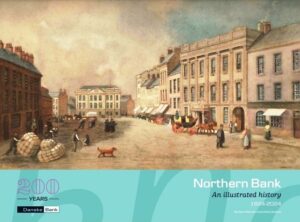
Book Cover
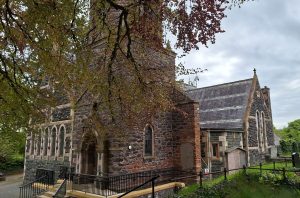 Hugh Montgomery (1743-1832) of Glenarm and Benvarden, Co. Antrim was one of the original founders or partners of the private bank, ‘H Montgomery & Company’ that was formed in Belfast in 1809. Around 1815 it became known as Northern Bank. He retired as a partner in 1822. His son, another Hugh Montgomery (1794-1867) succeeded his father in the partnership.
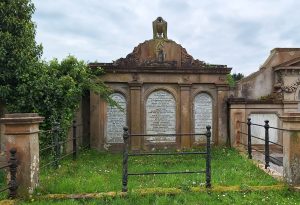 Hugh’s son, James C Montgomery was appointed as an additional Director in 1860. His health did not allow him to take up his duties and he resigned in 1862. He died abroad, in 1870 aged 34.