
A three-light and tracery window in the North Transept window of Belmont Presbyterian Church which commemorates Robert Ferguson JP of Sydenham House.
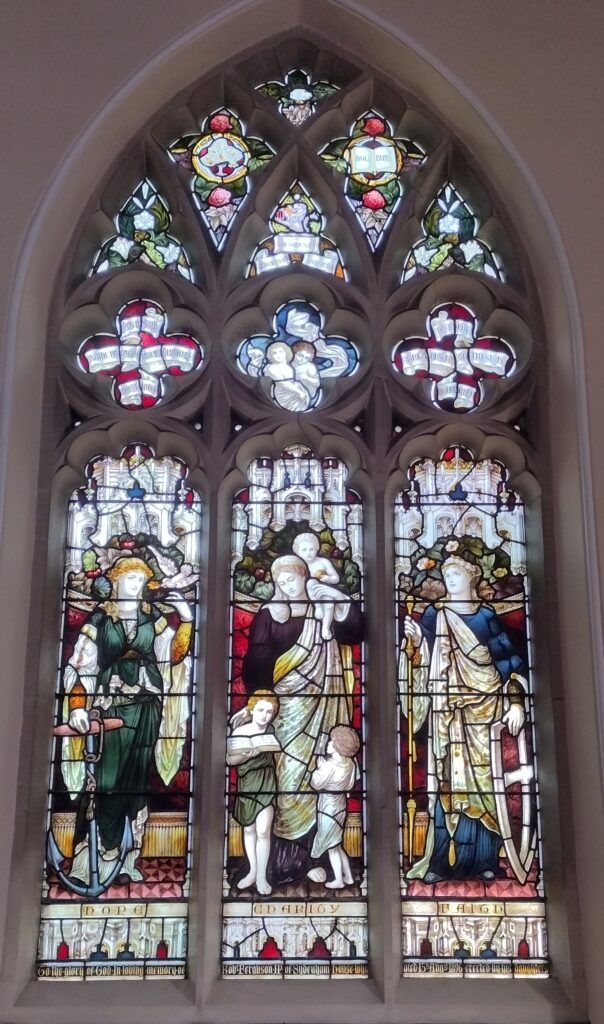
The North Transept window of Belmont Presbyterian Church ©Nigel Henderson
The overall theme of the window is to be found in 1 Corinthians 13:13 – And now abideth faith, hope, charity, these three; but the greatest of these is charity (King James Version). The text is present in the quatrefoils on either side of a quatrefoil depicting two cherubs. Above the central quatrefoil is a light depicting the coat of arms of the Ferguson family, with the motto, Virtutis Fortuna Comes (a Latin phrase that translates as fortune is the companion of virtue or fortune favours the brave). In the upper tracery light are the Burning Bush symbol of the Presbyterian Church in Ireland and an open Bible.
The three lancet light feature pre-Raphaelite female figures. The first lancet light represents HOPE and depicts a woman with her right hand on an anchor (We have this hope as an anchor for the soul, firm and secure, Hebrews 6:19). The light also features the dove returning to the ark with the olive branch. The second lancet light represents CHARITY and depicts a woman in fine clothing with three children whose clothing is basic. The third light represents FAITH and depicts a woman holding onto the Shield of Faith which extinguishes doubts, fears, and attacks (a reference to the Armour of God, Ephesians 6:10-18). Overall, the iconography would be more in keeping with a window dedicated to a woman known for her philanthropic activities.
The dedication reads, “To the Glory of God and in loving memory of Robert Ferguson JP of Sydenham House who died 15th August 1896. Erected by his daughters.”
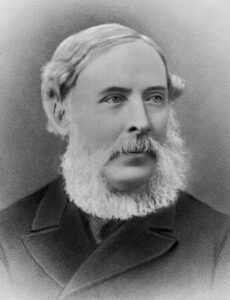
Robert Ferguson ©Aidan Campbell, East Belfast Historian
The window was designed by Heaton, Butler & Bayne of London, a firm that operated from 1852 to 1953 and specialised in stained glass windows in the Gothic Revival style. There are numerous examples of the work of this studio in churches across Ireland, mainly in Anglican churches.
Robert Ferguson was born on 13th April 1818 at Bathgate in Scotland to James Ferguson and Mary Ferguson (nee Alexander). Robert was a merchant and living at 3 College Square when he married Mary Anderson on 11th July 1861 at Dundonald Presbyterian Church.
Mary was born on 30th October 1832, and her father was the principal of David Anderson & Son, Lagan Feltworks, Short Strand. Robert and Mary lived at Maryville in Sydenham in the 1860s and at Sydenham House, Strandtown, from the mid-1870s. Sydenham House was bounded by the Holywood Road and the Belmont Road and what are now Ranfurly Drive, and Edenvale Drive. Sydenham Drive, Ferguson Drive, and Bathgate Drive (named after Robert’s birthplace) were established on the site of Sydenham House.
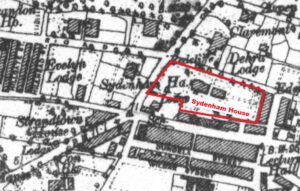
© OSNI Historic Maps (Third Edition)
In 1853, William Robertson and Henry Hawkins from Waterford established a wholesale drapery firm, which soon became a commercial department store. Its premises were in the 1785 Bank Buildings at the junction of Donegall Place, Royal Avenue, and Castle Street.
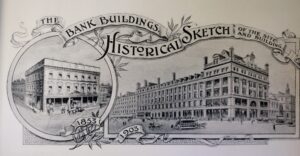
© “The Bank Buildings, Belfast – The Progress of Half a Century, 1853-1903”
In 1855, the firm oversaw the erection of the second building on the site. The firm was recorded as Hawkins, Robertson and Company in the 1861 Belfast Street Directory but as Hawkins, Robertson, Ferguson and Company in the 1868 edition. In 1875, Robertson and Ferguson partnered with James Ledlie from Cork to form Robertson, Ledlie, Ferguson and Company. The firm also had premises in Cork, Waterford, and Dublin. The firm continued to operate from the 1855 Bank Buildings until the current (1900) edifice, which was designed by William Henry Lynn, was built. Although Robert Ferguson had died in 1896, the firm name was still recorded as Robertson, Ledlie, Ferguson and Company in the 1960 street directory.
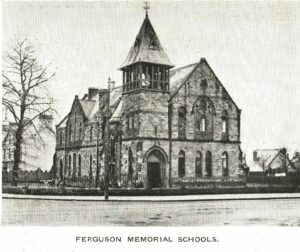
Mary Ferguson had suffered from congestion of the liver for one year when she died of pneumonia at Sydenham House on 10th December 1887, aged 56. After her death, Robert considered erecting a stained-glass window in Belmont Presbyterian Church in her memory. This possibly explains the female-oriented iconography of the window. Instead, he donated £1,000 (nearly £115,000 in current terms) to the Belmont Presbyterian Church Committee to build and furnish a school and enclose the ground as a memorial to my dear wife and to be named as such.
© “Belmont Presbyterian Church – Its Growth and Development. 75 Years of Congregational History, 1862-1937”
The Ferguson Memorial Schools were officially opened and presented to Belmont Presbyterian Church on 11th July 1890 but were administered under the National School System. The Gothic style edifice, constructed from Scrabo stone with Dumfries sandstone dressings, was designed by Mr Vincent Craig CE of Lombard Street and the principal contractor was Dixon & Campbell of Clifton Street. The building was also used for concerts and exhibitions; it is now called Belmont Tower and is owned by the National Trust.
©Nigel Henderson
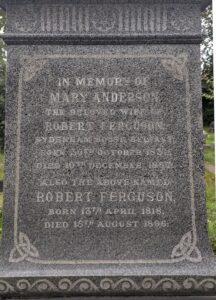
Robert Ferguson died of chronic bronchitis and pneumonia at Sydenham House on 15th August 1896, aged 78. He left effects of £127,008, which equates to approximately £15 million in current terms. Robert and Mary Ferguson are buried in Belfast City Cemetery.
History Hub Ulster Researcher Nigel Henderson