
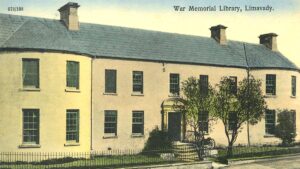
 The Limavady War Memorial Institute was formally opened on Thursday 2nd March 1922 by Major General Sir Oliver Nugent, who had commanded the 36th Ulster Division for much of its active service in France and Flanders. However, the story goes back to the weeks that followed the signing of the Armistice in 1918.
On 28th November 1918, a public meeting of the inhabitants of Limavady and the surrounding district determined that an institute would be the most fitting form of commemoration for the men from the district who had served in the Great War. The Institute would enable the inhabitants of the district of every class and denomination access to the benefits of a free library as well as other recreational facilities. On the night that the scheme started, £800 was promised to the subscriptions scheme – that equates to about £48,370 in current terms. A local solicitor, Mr Edward Maurice Fitzgerald Boyle of Gorteen, offered a free site for the erection of the building and the scheme received a significant financial boost when Mr George Lowry Moore, a native of the town but living at Forest Hill in London, donated £1,000 to the scheme. Due to the excessive of building materials and labour difficulties the scheme stalled until 1920. In April of that year, Major Alexander Boyle of Bridge Hill in Limavady died and his son, Edward Maurice Fitzgerald Boyle, sold the property to the War Memorial Committee for a reasonable sum and gave permission for the donated plot to be sold by the committee to fund the scheme. The process of altering the commodious mansion began and the final building, in addition to a free library, would contain reading rooms, billiard rooms, recreation rooms, and, importantly, rooms where the veterans could socialise and reminisce. On the north façade a grey granite stone recorded “War Memorial 1914-1918”. The property was vested in a Board of Trustees who were bound by their deed never to alienate the property from its original object. In the words of Mr Robert Douglas JP, Chairman of the Trustees, “Their aim was not to have an ornamental memorial, but one which would be serviceable, especially to those who had fought for them in Flanders and France”. The latter comment must have come as a surprise to the assembled veterans who had served at sea or in other theatres of the land war. 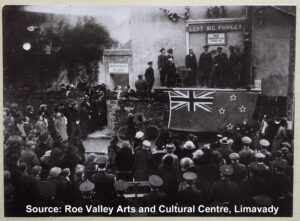
In his speech, Major General Nugent said that he had come not to be honoured but to pay a tribute to the gallant men of Limavady. He said that the record of the district was magnificent with 800 men enlisting from a population of 4,000 men, women, and children. He went on the say that 74 men had made the supreme sacrifice and that 25 of those men came from the local battalion, the 10th Royal Inniskilling Fusiliers. He commended the committee on the form of the memorial, and he wished every possible happiness and prosperity to those who would use the Institute and to the people of Limavady he wished an equal measure of happiness and prosperity in a united Ireland. His speech was greeted with cheers from the people attending the ceremony.
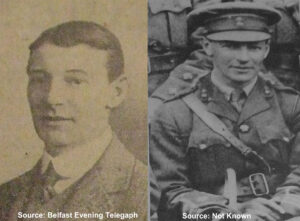 The Honorary Treasurer of the War Memorial Committee was Lieutenant Colonel Francis Samuel Needham Macrory of Ardmore Lodge. He had been commissioned as a Second Lieutenant in the Royal Engineers in February 1896 and held the rank of Major with 10th Battalion Royal Inniskilling Fusiliers when he was deployed to France in October 1915. He was awarded the Distinguished Service Order in the 1917 New Year’s Honours List, was mentioned in Despatches in January 1917 and again in December 1917. He was later Chairman of the Board of Trustees and he was Commanding Officer of 1st Londonderry Battalion Ulster Home Guard during the Second World War.
The Reverend Canon Richard George Salmon King, Rector of Christ Church was appointed as Chaplain to the Ulster Division in November 1914 and accompanied the Division to France the following October. Canon Richard King relinquished his commission in November 1916 and was awarded the Military Cross in the 1917 New Year’s Honours List.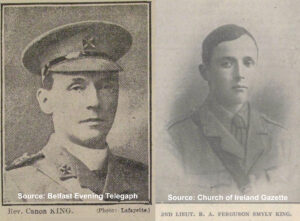
Canon King’s eldest son, Robert Andrew Ferguson Smyly King, held the rank of Lieutenant in 2nd Battalion Royal Dublin Fusiliers when he was wounded during the Battle of Le Bassee. He died of his wounds at No 7 Stationary Hospital on 23 May 1915, aged 19, and is buried in Boulogne Eastern Cemetery.
In early 1919, 32 men from the Limavady District who had been taken prisoner during the war were welcomed home by Mrs Catherine Anne Swetenham Trench (nee Lecky) of Graystone Hall and entertained in the Alexander Memorial Hall. Catherine Trench’s husband, Frederick Charles Bloomfield Trench, had been killed in action on 1st July 1916 and the Trench Memorial Flute Band was named in his memory.
In January 1919, Limavady Urban District Council had applied to the Secretary for War Office for a captured German gun to be awarded to the town. Although the council had already received two trench mortars, which had been place at the Institute, the council Limavady received the first of its two War Trophy guns in July 1923, the second arriving the following month. Both guns were howitzers with a bore of 210 centimetres, the first weighed six and a half tons and the second weighed seven tons.
On 7th May 1940, Limavady Urban District Council debated the sale of the trophy gun. Mr Campbell JP is quoted as saying, “I would certainly sell them, and send them back to Germany in another form.” The following month, Mr John Hunter, Chairman of the Council, announced that the two howitzer guns had been sold and the money raised, £21 and ten shillings, would be donated to the British Red Cross Society. The money raised from the sale of the guns would equate to approximately £1,300 in current terms.
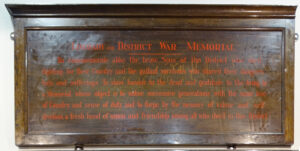
On Thursday 10th October 1924, a Roll of Honour made from dark Oak was unveiled in the Institute by Major Henry Hewey Francis MacDonald-Tyler who had served with the 9th Gurkha Rifle during the Great War and made a Companion of the Order of the Indian Empire. 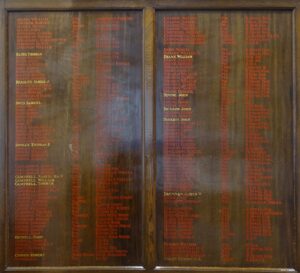 The dedicatory panel reads, “Limavady and District War Memorial, to commemorate alike the brave sons of this district who died fighting for their country, and the gallant survivors who shared their dangers, toils, and sufferings; to show honour to the dead and gratitude to the living by a memorial whose object is to imbue successive generations with the same love of country and sense of duty, and to forge, by the memory of valour and self-devotion, a fresh bond of union and friendship among all who dwell in this district.”
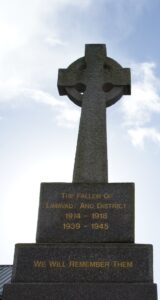
 In the late 1920s, a Celtic Cross was erected at the Institute and this became the focal point for Armistice Remembrance and the Limavady Branch of the British Legion received permission to use, free of charge, a Billiard Room and an Ante Room for meetings.
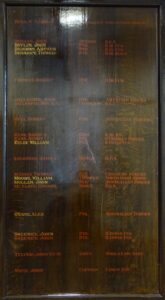
On 28th March 1972, a car bomb exploded outside Limavady RUC Station and caused significant damage to the War Memorial Institute, which was subsequently demolished. The Limavady and District Roll of Honour Boards were moved to the Town Hall and an additional panel of names was added. The Roll of Honour Boards were recently installed in the Roe Valley Arts and Cultural Centre and were unveiled on Tuesday 1st March 2022.
The Celtic Cross that had been erected at the Institute was incorporated into a new War Memorial which was unveiled in 2002 and incorporates panels naming those from the district who died in the two world wars, the Korean War, and during Operation Banner in Northern Ireland.
They shall grow not old, as we that are left grow old:
Age shall not weary them, nor the years condemn.
At the going down of the sun and in the morning
We will remember them
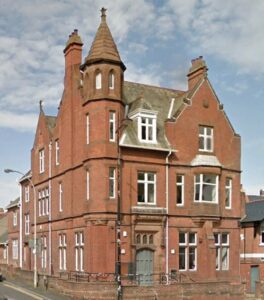 The Belfast Banking Company opened their branch in Warrenpoint in 1914. In 1970 the branch was rebranded as Northern Bank (Belfast Bank Branch). Danske Bank trading as Northern Bank closed the branch in 2013. Following a few years of redevelopment, the building is soon to go on the market as retail space and 2 apartments upstairs. This article presents the history of the building through historical maps, newspaper clippings, ledgers and photographs.
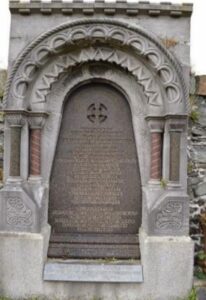 Guest author Ruth Allister has provided us an extensive history of the imposing McLean monument in the Priory Graveyard, Holywood.
 FOI (Freedom of Information) – Lists of British Army Personnel Deaths in NI, Iraq and Afghanistan
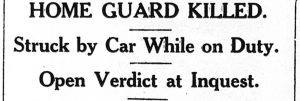 The first fatality on the CWGC list is Special Constable William Mould (Local Defence Volunteer, forerunner of the Ulster Home Guard) of Dunmurry who died at 4:30am on 8th September 1940 when he was struck by a vehicle with no lights when walking home whilst on duty. The car was driven by Lieutenant Ernest John Bloom, Corps of Royal Signals and reports on the inquest were carried by the Lisburn Standard and Lisburn Herald (on 13th and 14th September respectively). William Moulds had served with the Canadian Infantry during the Great War and is commemorated on the War Memorial in Derriaghy Church of Ireland. To date I have been unable to locate the burial location.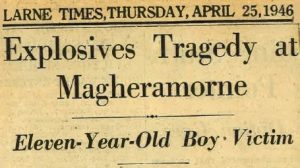
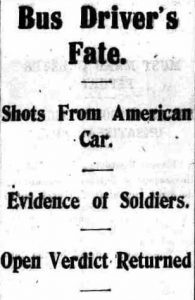 Rodden, accompanied by Frederick McMichael, was returning the bus to the depot in Ballyclare. In giving evidence, Frederick McMichael said that Albert had allowed several vehicles to pass the bus in Main Street, Dungiven before pulling out behind them – there was a further, but different car, behind the bus and the driver of the car sounded the horn and tried to overtake. At Farloe Lane, there was a wide place and Albert pulled in to let the car pass and, as the other car came along at a fast rate, McMichael heard a shot and the bus crashed into a wall. Driver De Felice said that when he tried to pass the bus, the car struck the kerb and his passenger, Sergeant Clipsham swayed with the sudden jerk and appeared to be dumbfounded as if he did not know what had happened. In giving evidence, Sergeant Clipsham reported that he was standing in the car and fell against the machine gun, which started to fire. The funeral at Ballykelly Presbyterian Church was a major affair, including representatives from the “B” Constabulary and the Ulster Home Guard, which would imply that he was providing part-time war service, yet his name is not recorded in the Books of Remembrance for civilian fatalities in the Second World War. The inquest was reported in the Derry Standard and the Derry Journal on 20th April 1942 and in the Londonderry Sentinel on 21st April 1942.
 When he was 50 yards from the house, the bomb exploded and Robert John Dodd was taked to Daisy Hill Hospital in Newry, where he later died. The inquest was reported in the Newry Reporter on 30th January 1943.
 Four North Down men drowned in the incident. Harry Aiken (21), William George Nelson (28, and a crew member of the Donaghadee Lifeboat) and William White (29) from Donaghadee are commemorated on the Donaghadee War Memorial and buried in the Donaghadee Church of Ireland graveyard. The body of William Sloan Anderson (28) from Bangor was washed ashore at Portpatrick in Scotland 38 days after the disaster and he is buried in the Bangor Cemetery and is commemorated on the Bangor War Memorial and on the War Memorial in the Wesley Centenary Methodist Church in Bangor. Although these men lost their lives whilst working under the direction of the Admiralty, they are not recorded as civilian war fatalities on the CWGC database. (additional material provided by Barry Niblock)
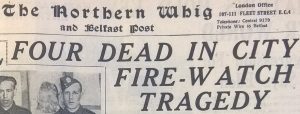 Messrs Redmond, Sons & Company, a manufacturer of packing cases, employed a night-watchman and fire-watchers at its premises on the corner of Connaught Street and Milner Street in the Village district of South Belfast. When William Elliott arrived at the works at 7:30am on the morning of 2nd December 1942, he found the night-watchman, Alexander Watson of Coolderry Street, lying on the floor in front of a gas fire and later found the four fire-watchers in their beds – two men, William Dowling of Donegall Avenue and James Campbell of Norfolk Drive, were already dead and the other two men were taken to the near-by Royal Victoria Hospital. George Leslie of Olympic Drive died in hospital but Henry Kavanagh (18) of Ross Street survived. The gas fire and the radiator in the sleeping quarters had been installed only ten days previously and, whilst William Elliott reported that he had noticed a strong smell of gas, a Corporation expert examined the radiator and reported that it was in perfect order and that there was no sign of an escape of gas. James Campbell (18) was buried in Milltown Roman Catholic Cemetery, William John Dowling (49) was buried in Dundonald Cemetery, George Leslie (37) was buried in Belfast City Cemetery and Alexander Watson (63) was buried in Lurgan Cemetery.